



 Fact Sheet
Tobacco use: California 2026
Cigarette use: California*
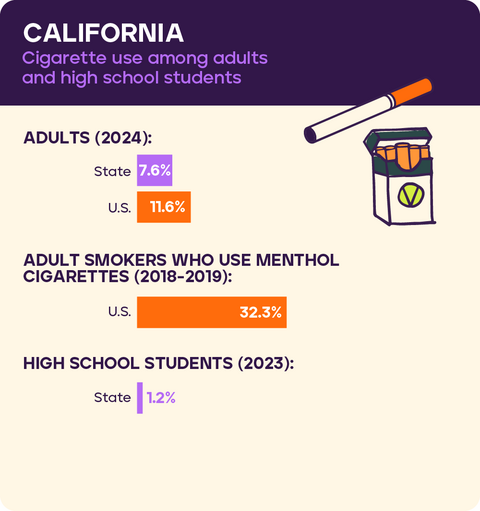
In 2024, 7.6% of adults in California smoked. Nationally, adult smoking prevalence was 11.6%.
In 2023, 1.2% of high school students in California smoked cigarettes on at least one day in the past 30 days.
Other tobacco product use: California*
In 2024, 6.6% of
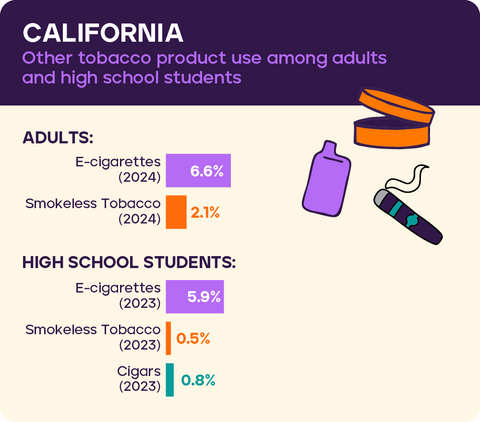
In 2024, 6.6% of adults in California used e-cigarettes. Nationally, the adult e-cigarette use prevalence was 8.0%.
In 2024, 2.1% of adults in California used smokeless tobacco every day or some days. Nationally, the adult smokeless tobacco use prevalence was 3.4%.
In 2023, 5.9% of high school students in California used electronic vapor products on at least one day in the past 30 days.
In 2023, 0.5% of high school students in California used chewing tobacco, snuff or dip on at least one day in the past 30 days.
In 2023, 0.8% of high school students in California smoked cigars, cigarillos, or little cigars on at least one day in the past 30 days.
cigars on at least one day in the past 30 d
Economics of tobacco use and tobacco control
- California received $2 billion (estimated) in revenue from tobacco settlement payments and taxes in fiscal year 2026.
Of this, the state allocated $171.2 million in state funds to tobacco prevention in fiscal year 2026, 49.2% of the Centers for Disease Control and Prevention’s annual spending target.
Smoking-related health care costs: $15.44 billion per year.
Smoking-related losses in productivity: $28.1 billion per year.
California tobacco laws
Tobacco taxes
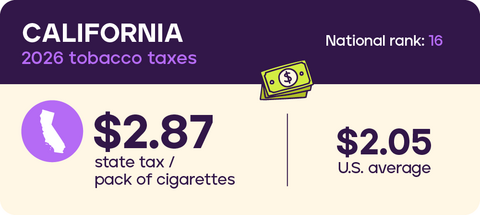
- California is ranked 16th in the U.S. for its cigarette tax of $2.87 per pack (enacted April 2017), compared with the national average of $2.05. (New York has the highest tax at $5.35 and Missouri has the lowest at 17 cents).
- E-cigarettes have an excise tax of 12.5% (as of July 1, 2022).
- All other tobacco products are taxed at 61.74% of the wholesale price.
Clean indoor air ordinances
- Smoking is prohibited in all government and private workplaces, public schools, restaurants, bars, casinos/gaming establishments (tribal establishments exempt), retail stores, and childcare facilities.
- Use of e-cigarettes is prohibited wherever smoking is prohibited (with some exceptions), including but not limited to enclosed places or employment, family day care facilities, foster and group homes, within 25 feet of playgrounds or 250 of a youth sports events, in public buildings or within 20 feet of a main exit, entrance, or operable window of a public building, in a state-owned passenger vehicle, in health facilities, cars with minors, on public transportation or passenger carriers, on grounds of facilities under the Department of Youth’s Authority jurisdiction (with the exception of residential staff housing where inmates or wards are not present), in nonprofit charitable temporary food facilities, outpatient health facilities, within 25 feet of the “commerce area” of certified farmers’ markets, and on a state beach or unit of the state park system.
- Schools may not allow students to use tobacco products, including e-cigarettes, on campus or while attending school-sponsored activities. School districts, charter schools and county offices of education must adopt and enforce policy prohibiting use of electronic cigarettes. The use of nicotine delivery devices is prohibited in county offices of education, charter schools, school/district buildings, school/district property, and school/district vehicles.
- The landlord of a residential dwelling unit may prohibit smoking of tobacco products, including electronic cigarettes, on the property or any portion of the building.
- E-cigarettes are included in the state’s clean indoor air laws and the state’s definition of smoking and tobacco products.
Flavor restrictions
- The sale of flavored tobacco products, except loose leaf tobacco, hookah, and premium cigars, is prohibited.
- A tobacco retailer, or any of the retailer's agents or employees, shall not sell, offer for sale, or possess with the intent to sell or offer for sale, a flavored tobacco product or a tobacco product flavor enhancer.
Licensing laws
- Retailers, wholesalers, and distributors are required to obtain a license to sell tobacco products.
- Retailers, wholesalers, and distributors are required to obtain a license to sell e-cigarette products.
Youth access laws
- In December 2019, the United States adopted a law raising the federal minimum age of sale of all tobacco products to 21, effective immediately.
- Establishments are required to post signs stating that sales to people under 21 are prohibited.
Baseball stadium laws
- The use of smokeless tobacco is prohibited in California’s five professional baseball stadiums.
Local tobacco laws
- Beginning January 1, 2027, Santa Cruz County will prohibit the sale of filterted cigarettes and cigars.
- Beverly Hills prohibits the sale of all tobacco products in the city; cigar lounges are exempt and guests in the city’s luxury hotels can acquire cigarettes through their concierge or room service. Manhattan Beach prohibits the sale of all tobacco products in the city.
- 41 localities have banned the sale of all e-cigarettes, with variances for those products that have received FDA premarket approval.
- 51 cities and counties have banned pharmacies from selling tobacco products, including Alameda County, Contra Costa County, Los Angeles County, Marin County, Pacifica, San Francisco, San Mateo County, Santa Clara County, and Sonoma County.
- San Francisco caps the number of tobacco sales permits in each of the city’s 11 districts at 45, and new tobacco retailers are prohibited within 500 feet of any school or another retailer.
Quitting statistics and benefits
- The CDC estimates 52.8% of daily adult smokers in California quit smoking for one or more days in 2019.
- In 2014, the Affordable Care Act required that Medicaid programs cover all quit medications.**
- California’s state quit line invests $4.08 per smoker, compared with the national median of $2.62
- California has a private insurance mandate provision for quitting tobacco.
Notes and references
* The datasets for both adults and youth prevalence were used to make direct comparisons at the state and national levels. National prevalence reported here may differ from what is reported in our national-level fact sheets. The numbers here also reflect the most recent data available. Dates of available data may differ across state fact sheets.
**The seven recommended quitting medications are NRT gum, NRT patch, NRT nasal spray, NRT inhaler, NRT lozenge, Varenicline (Chantix) and Bupropion (Zyban).
Fiore MC, et al. Treating Tobacco Use and Dependence: 2008 Update. Clinical Practice Guideline. Rockville, MD: US Department of Health and Human Services. Public Health Service: May 2008.
Updated March 2026.
1. CDC. (2024). Behavioral Risk Factor Surveillance System.
2. RTI International. (2024). Results of the 2023 California Youth Tobacco Survey.
3. Broken Promises to Our Children: A State-by-State Look at the 1998 Tobacco Settlement 27 Years Later. (2026). Campaign for Tobacco-Free Kids. https://www.tobaccofreekids.org/what-we-do/us/statereport
4. Campaign for Tobacco-Free Kids. (2024). The Toll of Tobacco in the United States. Campaign for Tobacco-Free Kids.
5. American Lung Association. (2024). State Legislated Actions on Tobacco Issues (SLATI).
6. American Lung Association. (2026). State of Tobacco Control. https://www.lung.org/research/sotc
7. Campaign for Tobacco-Free Kids. (2024). State Cigarette Excise Tax Rates & Rankings. https://assets.tobaccofreekids.org/factsheets/0097.pdf
8. California Legislation. (2021). SB-395 Excise tax: Electronic cigarettes: Health Careers Opportunity Grant Program: Small and Rural Hospital Relief Program. https://leginfo.legislature.ca.gov/faces/billNavClient.xhtml?bill_id=202120220SB395
9. Public Health Law Center. (2024, June 15). U.S. E-Cigarette Regulations: 50 State Review. https://www.publichealthlawcenter.org/resources/us-e-cigarette-regulations-50-state-review
10. Truth Initiative. (2024, June 30). Local restrictions on flavored tobacco and e-cigarette products. https://truthinitiative.org/research-resources/emerging-tobacco-products/local-restrictions-flavored-tobacco-and-e-cigarette
11. FDA. (2024). Tobacco 21. https://www.fda.gov/tobacco-products/retail-sales-tobacco-products/tobacco-21
12. Knock Tobacco Out of the Park. (2024). https://tobaccofreebaseball.org/
13. Filtered Cigarette Sales Ban To Go Into Effect In 2027. (n.d.). Retrieved October 23, 2025, from https://www.santacruzcountyca.gov/portals/0/county/CAO/press%20releases/2025/FilteredCigarettes.09222025.pdf?ver=2025
14. American Nonsmokers’ Rights Foundation. (2024). Municipalities with Tobacco-Free Pharmacy Laws. https://no-smoke.org/wp-content/uploads/pdf/pharmacies.pdf
15. San Francisco Health Code Article 19H (2014). http://www.sfbos.org/ftp/uploadedfiles/bdsupvrs/ordinances14/o0259-14.pdf
16. CDC. (2024). Behavioral Risk Factor Surveillance System, State Tobacco Activities Tracking and Evaluation System.
More in smoking by region
Want support quitting? Join EX Program
By clicking JOIN, you agree to the Terms, Text Message Terms and Privacy Policy.
Msg&Data rates may apply; msgs are automated.