


 Research Article
Social media platforms claim to protect their users, but rarely act on reported tobacco content
Instagram, TikTok, and YouTube all have community guidelines that restrict tobacco, nicotine, and cannabis content. However, a Truth Initiative study in the Journal of Online Trust and Safety found that the platforms rarely enforce their own community guidelines, allowing tobacco imagery to remain on the platform even when users report it.
To gauge platform responsiveness to a user report, Truth Initiative researchers identified 294 clear violations of community guidelines and reported each one through the platform's own user-reporting tool, as a regular user would. Reports were made between July 29 and October 16, 2025.
Key takeaways from this study:
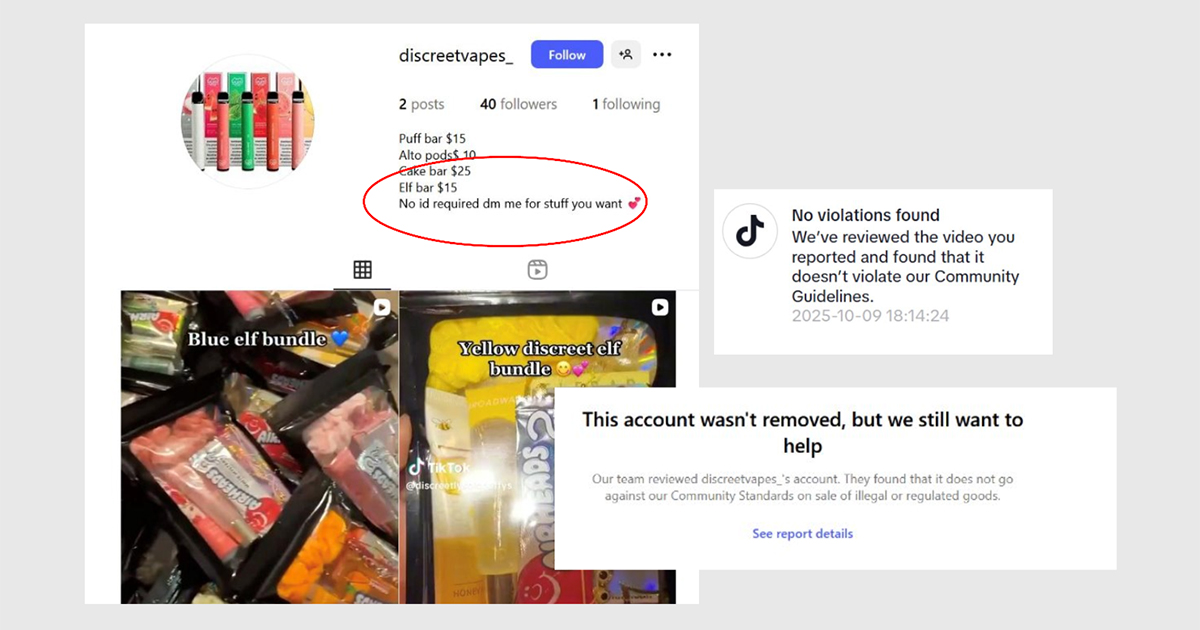
- Content that violates tobacco policies remains widespread on popular platforms. All three platforms prohibit or restrict vaping content, yet researchers were readily able to find violations using simple searches and platform recommendations. They found accounts openly selling e-cigarettes with "no ID required" or even stating “we sell to minors too.” Accounts also included paid influencer promotions, videos of underage vaping, and dangerous "challenges" like "pool noodle blinkers." The unmoderated posts alone accumulated an estimated 15.7 million views.
- Obvious violations, once reported, were rarely addressed. Overall, 75% of reported cases (221 of 294) went unmoderated. Instagram moderated 52% of cases, YouTube 14%, and TikTok just 8%.
- Moderation varied widely by type of violation. Instagram was effective at removing content related to illegal sales (32 of 36 cases), but TikTok removed only 1 of 36 and YouTube 2 of 29. Insufficient age-gating was the only category where more than half of cases (29 of 56) were moderated.
- Platforms fail to follow their own rules. Not only were violations ignored by the platforms, but TikTok and Instagram often responded to flagged content to state they found it not in violation of their guidelines, including accounts openly selling vapes with no ID required. In some cases, the platforms reported that content had been removed, but reviewers found it still viewable on the platform less than 48 hours after the platform claimed to have removed it.
Findings call into question whether platforms can be relied on to self-regulate
Community guidelines and content restrictions are seen as safeguards put in place to protect young people on the internet and on social media. This study suggests that while platforms promise to moderate harmful content, they often fail to enforce their own community guidelines, exposing users to potentially harmful content.
Tobacco imagery on social media has real consequences for young people
Seeing frequent tobacco content on social media or streaming platforms can have a real impact on young people’s odds of using nicotine.
According to a Truth Initiative study, young people exposed to high levels of user-generated, promotional tobacco content on YouTube, Twitch, and TikTok have nearly triple the odds of intending to use e-cigarettes compared to those who are not exposed.
Federal regulators must require that social media platforms enforce their policies, improve their reporting tools, and be more transparent about their limitations.
Policymakers should consider infrastructure that enables independent content monitoring and removal. The study's authors also note that this methodology could be applied to other public health themes that appear on social media, such as self-harm and eating disorders.
More in tobacco in pop culture



Want support quitting? Join EX Program
By clicking JOIN, you agree to the Terms, Text Message Terms and Privacy Policy.
Msg&Data rates may apply; msgs are automated.